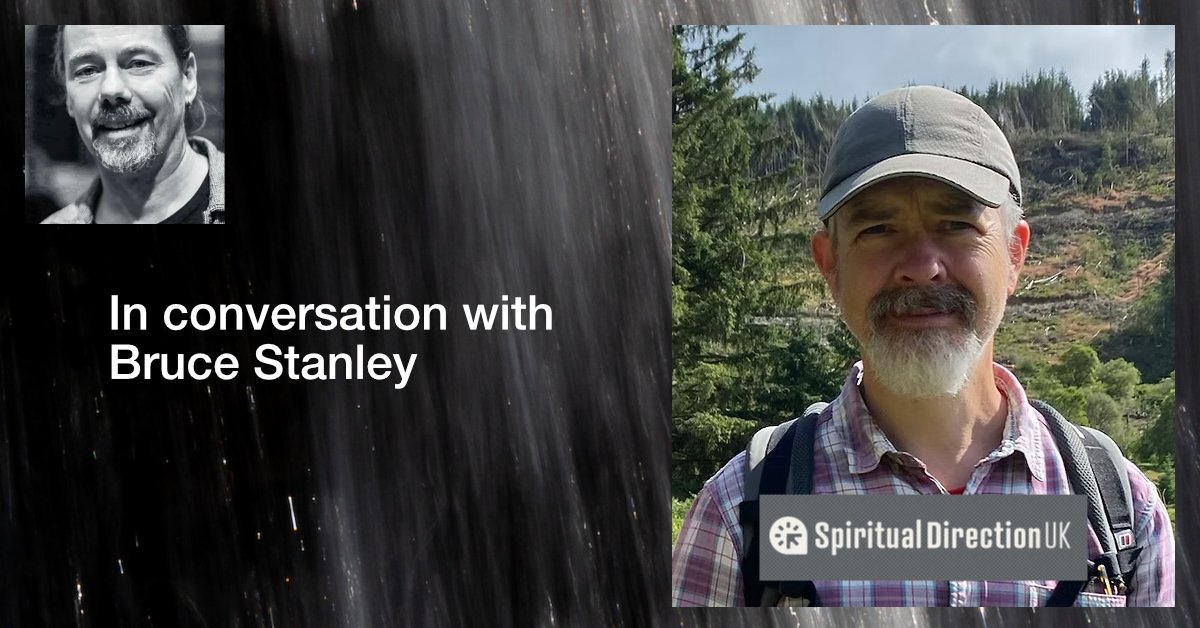
in the last few years i have trained to be a spiritual director. i am gradually developing spiritual direction as part of the mix of what i do or maybe who i am. i am accompanying a few people and am a guest director at st beuno’s a couple of times a year. i have not yet got round to saying much about it here so hope to add some things in the next year to the blog for anyone who is interested in that. a lovely surprise has been being invited into a new venture spiritual direction uk to be one of the directors. bruce stanley is the initiator and catalyst for that. in a separate post i’ll say more about spiritual direction uk (sduk) but i asked bruce some questions. his responses are laced with depth. it’s a longish read but i really recommend it both as a way of getting a sense of what spritual direction is about and what sduk is offering that is new into the space. i have already found myself coming back to it several times. anyway here’s the conversation.
What is spiritual direction and how did you get involved in the practice of it?
I think spiritual direction begins with the quality of attention. Most of us have plenty of conversations, but occasionally you have one where somebody listens to you so attentively that you begin to hear your own life differently. Spiritual direction deliberately makes space for that kind of conversation. In my 20s and 30s I would leave my spiritual direction sessions (as directee) with reams of notes and ideas and insights that would keep me engaged for weeks.
Traditionally prayer, vocation and discernment have been central topics but in my experience, offering the practice as a director far wider, a much wider range of topics are raised – but underneath them is listening, noticing what is happening, what keeps returning, what you are resisting, where life seems to be moving and what God (nomenclature often differs) might be doing in all of that.
There is quite a full process hidden inside the word listening. You notice something, question it, live with it for a while, perhaps forget about it and then something begins to come into focus. A good spiritual director helps you create enough space and attention for you to recognise what is happening yourself. This three-way deep listening is within the mainstream of the practice – attentiveness, open questions, reflection and discernment.
I came to it in my late twenties, although the seeds were probably there earlier. One word that reappeared in my twenties and thirties is discontented. I’ve always had a fairly low tolerance for the default answer. If something is simply how church is done, or what you ought to do with your life, some part of me starts asking whether it has to be that way.
The interesting thing is that the discontent doesn’t stay negative for very long. Almost immediately it flips into: Ooh – what could we have instead? Looking back, I can see that as one of the recurring patterns of my life. Something doesn’t quite fit, and curiosity takes over.
At the time my own spiritual life involved quite a lot of mysticism, questioning and trying to make sense of experiences that didn’t necessarily fit neatly into the conventional answers around me. I needed somewhere to sense-check that. Not somebody who would explain the experience away, but equally not somebody who would immediately tell me what God was saying – I wanted someone who could stay with the question with me. And, to be honest, someone I could trust would care and pray for me.
By then my own version of church was alt-worship in Bristol. We had a monthly service starting at nine at night which probably had more in common with an ambient club night than most people’s idea of Sunday worship. We were trying to make spiritual space for the people who weren’t going to turn up at conventional church on Sunday morning.
Back then I was a closet introvert and alongside all that group experimentation I became increasingly interested in the individual experience. What happens to the one person who is questioning, changing, experiencing God differently, and discovering that the people around them don’t necessarily have language for it? Spiritual direction seemed to offer a place for precisely that.
I trained as a spiritual director in my late twenties. What continues to interest me is helping people pay better attention to their own experience of God and their own response. Experience rather than abstract ideas is at the centre of spiritual direction.
Who is it for?
I’m tempted to say: anyone who needs this kind of conversation. You don’t need to be holy, certain or good at prayer or even sure what prayer is – but you probably do have some sense that there is something going on in your spiritual life that can’t be easily held alone, conveniently ignored or simplified away. For me, the need feels like there are rich seams of spiritual vitality that I can’t quite bring into focus on my own and in my sessions, my director helps me find them.
Some people are inside churches or spiritual communities but find themselves at the edge of where everybody else is comfortable. They are asking different questions, their experience of God is changing, or the inherited answers no longer quite fit. That can be surprisingly lonely. I suspect we can all recognise that territory.
Then there are people who have never really been inside those communities. They may never have thought of themselves as religious, but something in their spiritual life is deepening nevertheless. One mistake we make is imagining spirituality as something you decide to add to your life, like taking up Pilates. It feels much more two-way than that. Something reaches towards you, there’s a tap on the shoulder or a question won’t leave you alone. You have a strange experience, a recurring dream, a sense of presence, an unexpected longing, or you start questioning things you had previously taken for granted.
And that isn’t always lovely; spirituality isn’t necessarily scented candles and contemplative prayer. Sometimes something arrives in your life uninvited and you can sense your foundations cracking. You may welcome that eventually, but initially it can be confusing or destabilising. That’s one reason I understand the old analogy of the spiritual director as midwife – you’re accompanying something that is emerging.
There are also particular thresholds in life when these questions become louder. Emerging adulthood is an obvious one: Who am I? What kind of life is actually mine? I’ve done all the things I was told would make me successful, so why doesn’t this feel like enough? I used to meet people through coaching in their mid-to-late twenties who had the qualifications, career and apparent success, and had finally become quiet enough to hear a much more unsettling question underneath: Yes, but who do I actually want to become?
Midlife can reopen similar territory in a different form. The question shifts from What is my purpose? towards Am I actually living it? Loss, grief, trauma, burnout, vocation changes and other transitions can do something similar; they interrupt the story we’ve been telling about ourselves.
And I keep coming back to something from Day Crafting. Sometimes people want balance – and spiritual direction may help them find it. But sometimes the more interesting spiritual movement is precisely the opposite. Something needs to change. The life you have carefully balanced is no longer the life you are being invited to live. God is not another ingredient in a balanced life; sometimes God is the thing upsetting the balance.
That feels especially relevant to pioneers. The person out on the fringes may not have failed to fit the existing system, the edge may be exactly where their attention is being drawn.
You love innovation, it seems to be a big part of how you approach the world. SDUK is your latest project you are bringing to birth. It sounds as though that is a direct response to the ‘who is it for?’ To reach a new audience.
It’s funny, because from the outside I can see why people say I love innovation. From the inside it doesn’t start that way. It begins much more often with discontent. I encounter something and think, There’s a problem here. Surely this could work differently. Then very quickly that becomes the more enjoyable question: What could we have instead?
I think that probably explains a lot of what I’ve done. In the very early web – 56k modem territory – I once wanted to study online spirituality as part of an MA. The person running the course told me there was no such thing as online spirituality. So I went away and built an online sanctuary where people could light virtual prayer candles. This was Macromedia Director, chanting monks on a loop arriving down a dial-up connection. You clicked an unlit candle and it lit. It was taking an embodied spiritual gesture people understood from chapels and cathedrals and ask what it could become in a new medium.
That example matters to me because the innovation wasn’t Wouldn’t it be clever to put candles on the internet? It began with someone saying the spiritual experience couldn’t exist there. My instinct was: are we sure?
Spiritual Direction UK has similar roots, although it has taken rather longer to appear. When I lived in Bristol there was a listings magazine called Venue. At the back you’d find adverts for counselling, therapies, Reiki, psychics and all sorts of other ways people were exploring themselves and their lives. Once I discovered spiritual direction I was genuinely flabbergasted that it wasn’t there. Here was this extraordinary practice which seemed highly relevant to people already looking for meaning and spiritual experience, and we had somehow kept it almost entirely inside the church’s own distribution system.
The church has a strange talent for keeping some of its best stuff very well hidden.
Twenty-plus years later, that discovery problem is still real. We’ve done some secret-shopping around spiritual direction. In some places the experience is excellent, but finding it can involve obscure diocesan pages, insider networks, emailing somebody who knows somebody, or sending an enquiry and hearing nothing back.
For someone already uncertain about faith or belonging, that friction is a huge problem. The person may simply assume, This isn’t for people like me. That exact discovery problem is part of SDUK’s rationale. So the innovation isn’t really spiritual direction. The practice is ancient. The thing I’m bringing my product management experience to is the doorway.
What would happen if finding a spiritual director felt as normal and straightforward as finding other forms of skilled one-to-one support? What if you could discover who people are, understand what this term means, see availability and book without already being connected to the right network? My product management process is starting from the question What is the experience of somebody trying to find it? The crude product shorthand might be something like BetterHelp for spiritual direction, because people immediately understand the accessibility and discovery aspect.
The Christian instinct can be to begin by deciding who is inside and who is outside and then design accordingly. My instinct with SDUK is closer to: here is a practice rooted in the Christ tradition, here is the centre of gravity – andanyone who finds themselves drawn towards this kind of conversation is welcome to approach it. The interesting challenge is translating without diluting – being rooted without building a fence. That is also how SDUK’s own working brief frames the problem.
Tell us about Spiritual Direction UK
At its simplest, Spiritual Direction UK is a front door. You can arrive not knowing anybody, discover what spiritual direction is, meet a number of trained directors and book a conversation. That sounds embarrassingly mundane, but in this field it currently isn’t.
The bigger ambition is to make serious spiritual accompaniment more visible and accessible to people who would not know or think to ask a diocese, retreat house or priest for a recommendation. Some will be very at home with Christian language. Some will be standing uneasily at the edge of church. Some will describe themselves as spiritual but not religious. Some won’t yet know that the thing happening to them is something they might call spiritual. SDUK’s job is to make this kind of conversation discoverable; that basic inside church, on the fringes, or nowhere near it positioning is already part of the project.
And it’s a pilot. I want to emphasise that because I don’t think we know yet exactly what SDUK will become. We’re trying to be genuinely user-centred: talk to people, notice where they get confused or interested, see what they actually use, and build in response. Our internal shorthand is that the hard problem is discovery and trust. We’re experimenting: putting something into the world and finding out what engages – lean startup style.
I’d had the domain and some version of the idea for a very long time. Part of the reason it became possible now is simply that the technology has caught up. Twenty years ago, building booking, payment, availability and account systems without serious funding would have been prohibitively complicated. But there was another piece I needed more than technology: people.
I didn’t want to do it alone. I’ve built things alone before and know how hard it is to sustain hope when every piece of evidence, every problem and every decision comes back to one person. With SDUK there is already a group of directors around it, bringing different experience, relationships and ideas. It makes it much more possible for this to become something we discover together.
At the moment the recognisable unit of spiritual direction is still usually an hour-long conversation between two people, perhaps once a month, that is a deep and proven form. Innovation doesn’t mean messing with something merely because we can but it does ask whether that is the only form and how might different generations access it.
What might spiritual direction look like with a small group of pioneers who are each trying to discern what is emerging at the edges of their work? Could there be forms shaped around particular transitions or seasons? Could nature-based practice, retreats, group conversations, short encounters or other forms. Could it be a drop in WhatsApp group. One of our directors uses horses in her work – the four of you walk across Mull; you, the director, the pony and God.
There’s something almost contradictory about SDUK that I like. We’re taking a practice with very deep roots and asking what it looks like in a post-institutional marketplace. If somebody encounters SDUK and says, I didn’t know this existed, but this is exactly the conversation I’ve been looking for, then I think we’ve done something useful.